It isn’t what you think. And that’s exactly the problem.
Everyone has a reason they haven’t started yet.
Not enough time. Not enough money. Not the right moment. Waiting until the kids are older, the job is more settled, the idea is more formed, the confidence arrives. There’s always something plausible sitting between where you are and where you know you could be.
Here’s what thirty-five years of working inside some of the most complex, high-stakes organisations in the world taught me: the reason people give for not moving is almost never the real reason. It’s the presentable one. The one that sounds reasonable at dinner. The one that doesn’t require you to say anything uncomfortable out loud.
The real reason is quieter. Less obvious. And considerably more uncomfortable to name.
Stage One: You Won’t Start
The first place people get stuck isn’t at the starting line. It’s in the car park, three hundred metres before it, convincing themselves the race isn’t worth running.
This happens three ways, and most people do all three simultaneously.
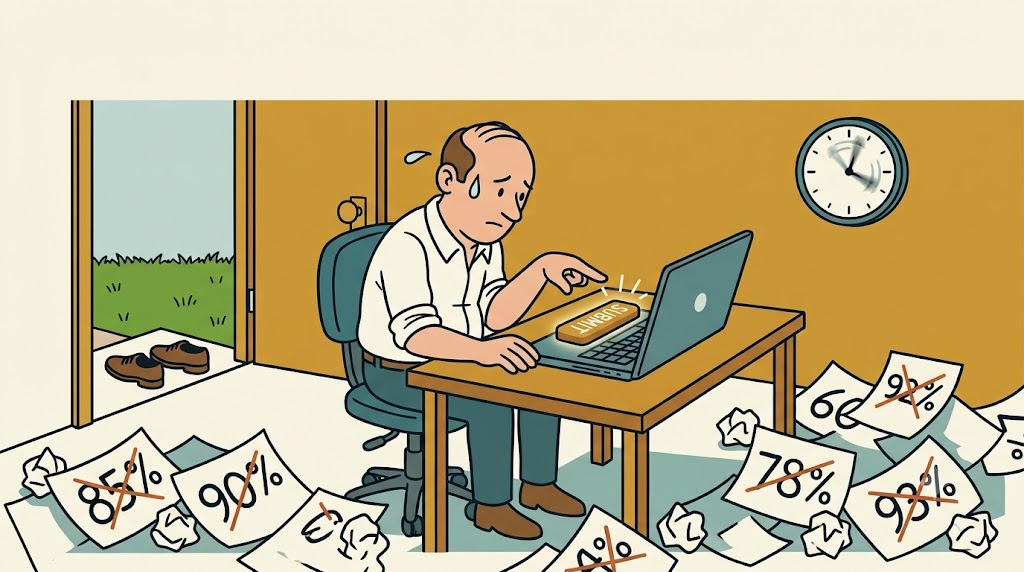
Overthinking dressed up as preparation. You research instead of deciding. You build the spreadsheet instead of making the call. You read one more book, watch one more video, take one more course, because somewhere in there might be the piece of information that finally makes you feel ready. It won’t. Readiness isn’t a feeling that arrives. It’s a decision you make before the feeling shows up.
Fear dressed up as caution. This one is clever because it sounds responsible. “I’m just being realistic.” “I don’t want to rush into anything.” “I need to think it through properly.” None of that is wrong on its face. The problem is when thinking it through properly has been happening for eighteen months and nothing has changed except the list of reasons it might not work has got longer. That’s not caution. That’s fear with a suit on.
Other people’s unthoughtful comments absorbed as verdicts. Someone says “that’s a bit risky isn’t it” at a family dinner and suddenly it lodges somewhere it has no business being. A colleague raises an eyebrow. A friend asks “but how would that actually work?” and you don’t have a perfect answer, so you take their question as evidence that it won’t. Other people’s opinions about your life are almost always based on their own fears, not your actual situation. The people most likely to tell you something can’t be done are the people who never tried.
The combination of these three things creates a paralysis that feels like patience. It isn’t.
Stage Two: You Won’t Finish
Some people get past the starting line. They make the decision, they take the first step, they tell a few people what they’re doing. Then something happens.
It doesn’t go perfectly immediately. Someone doesn’t respond the way they hoped. The first attempt doesn’t land. There’s a week of silence, or a piece of negative feedback, or the initial momentum slows down because momentum always slows down before it builds again, and they stop.
Not loudly. Not dramatically. They just quietly redirect.
They call it a pivot. They say they’ve reconsidered the approach. They reframe stopping as strategy. And maybe sometimes that’s true, but more often it’s the same fear from Stage One, just wearing a different coat. Instead of “I’m not ready to start” it becomes “I’ve thought about it and this isn’t the right direction.” The conclusion is the same. Nothing moves.
The brutal truth about finishing is this: the dip between starting and gaining traction is where most people quit, and it’s also completely normal. Every person who has ever built anything has sat in that dip wondering if they’ve made a terrible mistake. The difference between people who get through it and people who don’t is not talent, intelligence or even effort. It’s the willingness to stay in motion when motion feels pointless, and to have someone in your corner telling you the difference between genuine new information and fear recycling itself as logic.
Stage Three: You Won’t Read What Actually Happened
This one is the most sophisticated failure mode and the least talked about.
Some people start. Some people push through. And then they look at the results and see what they want to see rather than what’s actually there.
Early silence gets misread as failure and they quit before the data means anything. Early enthusiasm gets misread as validation and they scale before anything is proven. They ask their friends and family for feedback, the single most useless data source available, because the people who love you will almost never tell you something is genuinely bad, and the people who don’t know you well enough to be honest aren’t invested enough to bother.
The technical term for what happens next is confirmation bias. The plain English version is: people build a story around their results that lets them feel good about whatever they’ve already decided to do. If they want to continue, the results confirm they should continue. If they want to stop, the results confirm they should stop. The actual data rarely gets a fair hearing.
This is what I call fairy-storying the feedback. Constructing a narrative that feels true because it’s emotionally convenient, rather than because it’s what the evidence actually shows. It’s not dishonesty, most people doing it have no idea they’re doing it. That’s precisely what makes it so effective at keeping people stuck.
So What’s The Actual Answer?
The real reason most people never get anywhere is not a lack of ability, intelligence, opportunity or even effort. It’s that they go through the same three loops repeatedly without ever naming what’s actually happening inside each one.
They think they have a strategy problem when they have a starting problem. They think they have a direction problem when they have a finishing problem. They think they have a results problem when they have a reading-the-results problem.
And because the real problem stays unnamed, every solution they try is aimed at the wrong thing. Which is why it feels temporary. Which is why six months later they’re in the same place, with a slightly longer list of things they’ve tried that didn’t work.
Naming the real problem is most of the battle. The rest is having the structure and support to move through it honestly, not to have someone tell you what you want to hear, but to have someone in your corner who will tell you what’s actually there.
That’s the whole of what I do.
If any of this landed, you already know which problem you’re actually in.