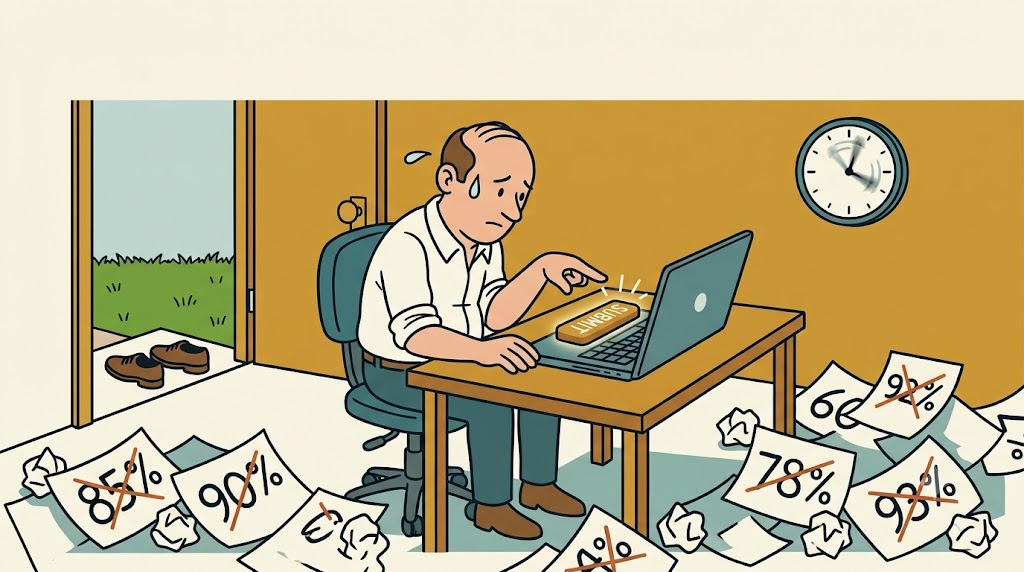
You’ve been asking the wrong people the wrong questions and calling the answers research.
At some point after you start something, you’ll want to know if it’s working.
That’s a reasonable instinct. The problem is what most people do next.
They ask their partner. Their best friend. Their mum. A colleague who’s known them for fifteen years. Someone in a Facebook group who liked their last post. Maybe they send a message to a handful of people who expressed vague interest early on and take the responses as data.
None of that is feedback. It’s noise with a friendly face. And the decisions people make based on it are some of the most expensive mistakes I’ve seen, not in the dramatic blow-everything-up sense, but in the quieter, more corrosive sense of staying on the wrong path too long, or abandoning the right one too early, because the signals they were reading were never real signals to begin with.
The People Who Love You Will Lie To You
Not deliberately. Not maliciously. But they will.
When someone who cares about you looks at what you’ve built, what you’ve written, what you’ve started, they are not evaluating it objectively. They are evaluating it through the lens of not wanting to hurt you, not wanting to discourage you, and genuinely hoping it works out because they want good things for you.
That is not the lens you need.
You need the lens of someone with no emotional investment in your feelings and a genuine stake in whether the thing works. That person is almost never in your immediate circle. Which means the warm, encouraging responses you’ve been collecting from people who love you are not validation. They’re kindness. And kindness, however well-intentioned, is a terrible basis for a business decision.
The People Who Don’t Know You Will Flatter You
The other common source of early feedback is strangers online. Comments, likes, shares, the occasional “this really resonated with me” in the replies.
This feels like signal. It isn’t, or at least not the signal most people think it is.
Engagement and conversion are entirely different things. Someone liking your post costs them nothing. Someone buying your product, joining your community, or booking a call costs them something real. The gap between those two actions is enormous, and filling it with assumptions about what the engagement means is one of the most reliable ways to build something nobody actually pays for.
I’ve watched people spend months, sometimes years, creating content that got consistent engagement and zero commercial traction, convinced they were building something because the numbers felt good. The numbers were measuring the wrong thing. Attention is not the same as interest. Interest is not the same as intent. Intent is not the same as a decision.
The People Who Push Back Are Not Always Wrong
Here’s the uncomfortable flip side.
Because most people around you will be encouraging, the occasional person who pushes back tends to land with disproportionate weight. One critical comment after twenty positive ones somehow carries more authority than all twenty combined. One person who says “I don’t really see the point of this” can undo weeks of quiet momentum.
That’s not because they’re right. It’s because doubt is already present and criticism gives it somewhere to live.
The question worth asking about any critical feedback is not “are they right?” It’s “do they have standing to have an opinion on this?” A person who has never built anything, never taken a risk, never put something they care about in front of strangers and asked people to pay for it, has no standing to evaluate whether yours will work. Their opinion is based on their own unlived fears, not your actual situation.
That doesn’t mean all criticism is wrong. It means the source matters as much as the content, and most people never stop to ask whether the person giving the feedback has earned the right to give it.
What Useful Feedback Actually Looks Like
Real feedback comes from people who have paid for something, or explicitly decided not to. Everything else is opinion.
Someone who joined your community and then left is more useful than a hundred people who said they’d think about it. Someone who bought once and never came back tells you something. Someone who was interested enough to enquire but didn’t convert tells you something. The absence of action from people who expressed interest tells you something. None of that requires a survey or a focus group. It requires paying attention to behaviour rather than words.
Because what people say and what people do are almost never the same thing.
People will tell you they’d buy it if it were cheaper. Then you make it cheaper and they still don’t buy it. People will tell you they’d join if you added a certain feature. Then you add it and they still don’t join. People will tell you the timing isn’t right. The timing is never right. These are not honest objections to be solved. They are polite ways of saying no that feel kinder than saying no.
Learning to distinguish between a real signal and a comfortable story told by the wrong people is one of the most practically valuable skills anyone building something can develop. It’s also one of the least taught, because most business advice is focused on how to get feedback, not on how to work out which feedback is worth anything.
The Story You’re Telling Yourself About The Results
There’s one more layer to this, and it’s the most uncomfortable one.
Even when you do get real feedback, real data, real behaviour from real people, there’s a strong human tendency to construct a narrative around it that confirms whatever you’ve already decided.
Good results and you want to continue? The results prove you should continue. Bad results and you want to stop? The results prove you should stop. Bad results and you want to continue anyway? The results are an anomaly, a bad week, too early to draw conclusions. Good results and you want to stop? You got lucky, it won’t last, the real picture is more complicated.
This isn’t dishonesty. It’s how human cognition works under uncertainty, and it affects everyone, including people who know it’s happening. The only partial defence against it is having someone outside your own head who will read the same results without your emotional investment in the conclusion, and tell you plainly what they actually show.
That’s a harder thing to find than most people expect. And it’s worth considerably more than most people pay for it.
So What Do You Do With This?
Stop asking people who love you whether your idea is good. They cannot tell you.
Stop treating engagement as evidence that you’re building something people will pay for. It isn’t.
Stop giving disproportionate weight to the one critical voice in a room full of encouragement, and stop dismissing critical feedback entirely just because it stings. Work out whether the source has standing first.
Pay attention to what people do, not what they say. Behaviour is data. Words are often just words.
And find someone who will read your results without needing them to say a particular thing. Not a cheerleader. Not a critic. Someone who will tell you the truth about what’s actually there, because that’s the only version of feedback that’s actually useful.
Everything else, however well-intentioned, is just noise.
[If you want that kind of conversation, this is where it starts.]